
Last updated November 21, 2026
 Raised-panel steel
 Carriage house
 Modern flush
 Full-view glass
 LiftMaster openers
 Chamberlain openers
Full 25-point door and opener safety check with every visit - springs, cables, rollers, tracks, and your LiftMaster or Chamberlain opener included
You get a price before we start. It does not change when the pro arrives.
Get your free estimateGarage Door Repair Maintenance Schedule: What to Do and When
The number one reason garage doors fail before their rated cycle life isn’t neglect. It’s the wrong lubricant applied to the wrong part. We’ve opened doors where a homeowner faithfully sprayed WD-40 on every moving piece twice a year, and the plastic rollers were swollen and flat-spotted while the actual springs sat dry and rusting. Maintenance isn’t a single annual ritual. It’s a set of intervals matched to how each component actually wears. This guide gives Carrick homeowners a practical, interval-based schedule: what to check monthly, what to lubricate quarterly, what to test annually, and what to replace on a calendar rather than a symptom. You’ll finish knowing which tasks are yours, which need a technician, and which lubricants belong on which parts.
Quick Answer
A garage door maintenance schedule works best on four intervals. Check cables and the door’s overall condition visually every month. Lubricate rollers, hinges, and the torsion spring quarterly with the right product for each material. Test spring tension, door balance, and opener force annually. Plan on spring replacement every 5 to 7 years even if the spring still looks intact. Freeze-thaw cycles in the Pittsburgh area make the seasonal checks matter more here than in milder climates.
Styles & brands we work with
- Raised-panel steel
- Carriage house
- Modern flush
- Full-view glass
- LiftMaster openers
- Chamberlain openers
Table of Contents
- Why Interval-Based Maintenance Beats an Annual Checklist
- The Monthly Check: Ten Minutes That Catch Failures Early
- The Quarterly Lubrication Routine
- Which Lubricant Goes Where (and What Never to Use)
- The Annual Tests: Spring Tension, Balance, and Opener Force
- Spring Replacement: Why the Calendar Matters More Than the Symptom
- Seasonal Adjustments for Pittsburgh-Area Winters
- Building a Maintenance Log a Technician Can Actually Use
- When to Call a Professional
Why Interval-Based Maintenance Beats an Annual Checklist
The standard advice is to “lubricate your garage door once a year.” That guidance treats a torsion spring, a nylon roller, and a steel hinge as if they wear at the same rate. They don’t. A roller spinning thousands of times a year and a spring twisting through full cycles are under completely different loads. A hinge pin that sees a fraction of that movement fails on a different clock entirely.
Matching the task to the wear pattern is what actually extends a door’s life. In our experience, the doors that reach their rated cycle count are the ones where someone understood which parts needed frequent attention and which needed inspection instead of handling. Carrick’s housing stock includes plenty of older doors with original steel rollers and builder-grade openers from brands like Genie and Chamberlain, and those systems respond well to a schedule that respects how the parts age.
Here’s the framework this guide uses:
- Monthly: visual inspection only. Cables, rollers for cracks, weather seal condition.
- Quarterly: lubrication with the correct product for each material.
- Annually: mechanical tests that require some force and judgment – balance, spring tension, opener force calibration.
- Every 5 to 7 years: planned spring replacement, whether or not the spring shows symptoms.
One note before going further: a garage door’s springs and cables are under high tension at all times. They can cause serious injury if handled incorrectly. Everything below describes what to check and what to observe, not how to disassemble or adjust spring tension yourself. That work belongs with a trained technician.
The Monthly Check: Ten Minutes That Catch Failures Early
A monthly walk-around is the cheapest maintenance you can do. You’re not fixing anything. You’re looking for the early signals that precede a failure, while the door still works.
- Look at the cables. With the door closed, inspect both lift cables along their length. You’re looking for fraying, kinks, or strands that have separated. A cable that’s starting to fail shows it visually before it snaps. If you see fraying, stop operating the door and call a technician.
- Check the rollers. Look at each roller where it meets the track. Nylon rollers should look smooth and round. Steel rollers should be free of flat spots. Cracked or chipped rollers score the track over time.
- Run a finger along the bottom seal. A weather seal that’s hard, cracked, or torn lets water and cold air in. In Carrick’s freeze-thaw winters, a compromised seal is also where ice starts to build.
- Listen. Open and close the door once and pay attention. Grinding, squealing, or a door that shudders mid-travel is telling you something. A quiet door is a well-adjusted door.
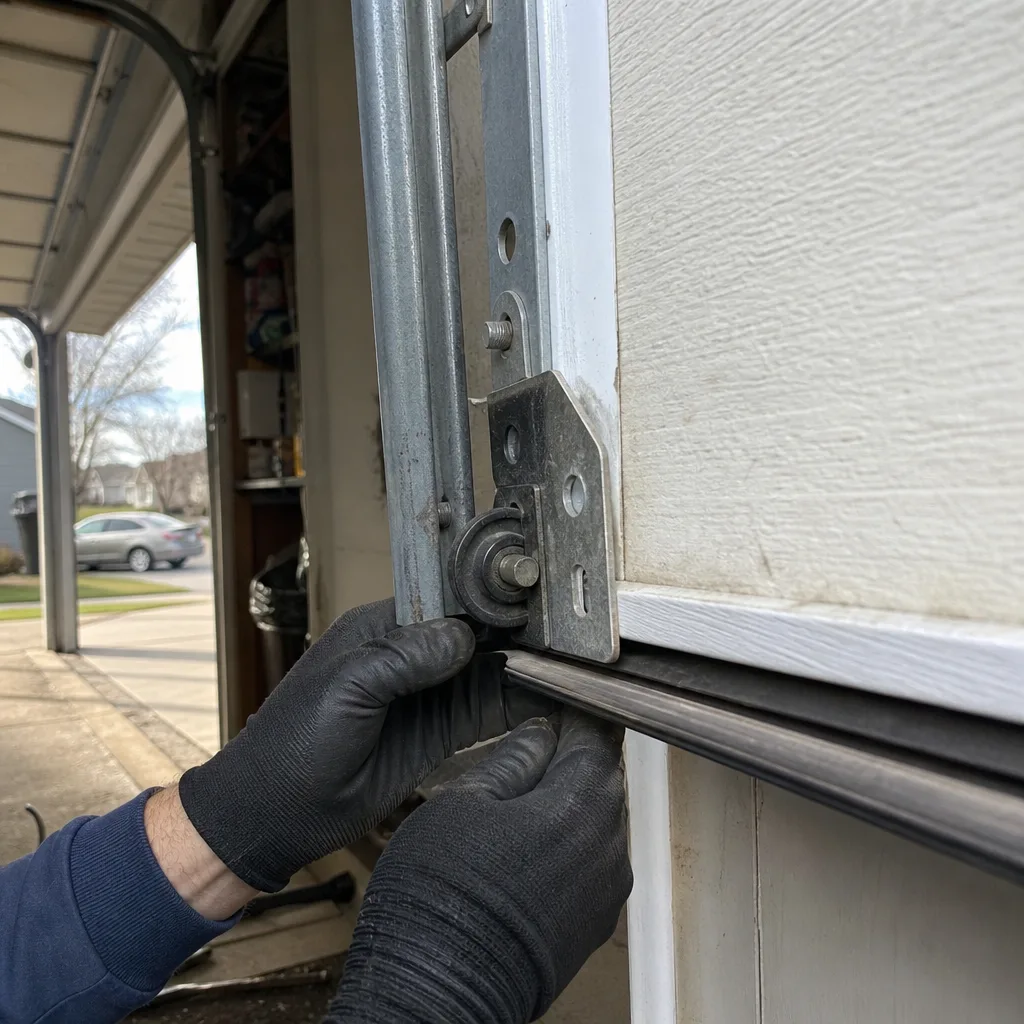
- Check the hardware. Look at the hinges and the brackets holding the track. Loose bolts are common and easy to spot. Tightening a loose hinge bolt is a reasonable homeowner task; adjusting track alignment is not.
Ten minutes once a month is enough. The point isn’t thoroughness. It’s familiarity, so that when something changes, you notice it.
The Quarterly Lubrication Routine
Lubrication is the task most homeowners get wrong, and it’s the one that does the most damage when done wrong. The goal is a thin film on the right surfaces, not a coating everywhere.
Every three months, apply lubricant to these points:
- Roller bearings and stems – one short spray at each roller where the stem meets the bearing.
- Hinge pivots – a drop at each hinge joint, not a spray across the whole hinge.
- Torsion spring coils – a light application along the coil. This reduces friction between coils without attracting grit.
- Track surfaces – a very light wipe, not a spray. The rollers should roll; the track should not be greasy.
What you should not lubricate: the opener rail (unless the manufacturer specifies it), the photo-eye lenses, and the bottom weather seal. Grease on those parts attracts dirt and degrades the seal material.
The reason quarterly matters rather than annual is that lubricant migrates and evaporates. A door that gets one heavy annual application is dry for months at a stretch. That’s when metal-on-metal wear happens. When you’re ready to move beyond the routine, our garage door repair page covers what a service visit involves and how we work through a door top to bottom.
Which Lubricant Goes Where (and What Never to Use)
This is where most maintenance goes wrong. The products that work on one part damage another. Here’s the breakdown:
- White lithium grease: the right choice for steel hinge pivots, roller stems, and torsion spring coils. It stays put, handles load, and doesn’t run.
- Silicone spray: the right choice for plastic and nylon parts, weather seals, and the track surface. It’s dry, doesn’t attract grit, and won’t degrade rubber or plastic.
- Nothing at all: the right choice for the opener motor housing, the photo-eye lenses, and any sensor hardware.
Now the products to keep away from your door. WD-40 is a penetrant and solvent, not a long-term lubricant. It displaces moisture and frees a stuck bolt, but it also dissolves the lubricant already inside a roller bearing and then evaporates. Applied regularly to nylon rollers, it can accelerate the breakdown of the material. 3-in-1 oil is a light machine oil that runs off vertical surfaces and collects dust, which turns into a grinding paste on hinges and tracks. Neither belongs in a maintenance routine.
If you’re not sure what’s currently on your door, a simple rule works: use white lithium grease on metal, silicone spray on plastic and rubber, and nothing on electronics. That covers nearly every part of a residential system, including the hardware on a Clopay or Amarr door that’s been in place for a while.
The Annual Tests: Spring Tension, Balance, and Opener Force
Once a year, it’s worth testing the door’s mechanical condition rather than just looking at it. These tests require the door to be disconnected from the opener, so do them with care and stop if anything feels wrong.
- Test the balance. Pull the opener release cord to disconnect the door, then lift the door halfway and let go. A well-balanced door holds its position. A door that drops is a sign of spring or cable trouble.
- Look at the springs without touching them. With the door closed, examine the torsion spring along its length for gaps, rust trails, or a visible separation. Any of those signals means the spring is failing, and a technician should see it before the door is used again.
- Test the opener’s safety reverse. Place a roll of paper towels under the door and close it. The door should reverse on contact. If it doesn’t, the opener force needs calibration.
- Check the opener’s force settings. This is a calibration task, not a strength contest. The door should move smoothly in both directions without straining, but should still reverse on an obstruction. Modern openers from Chamberlain and LiftMaster have force-setting instructions in their manuals.
- Inspect the tracks for alignment. Stand back and look down the tracks from the door opening. Both tracks should look parallel and straight.
If balance or force feels off, don’t adjust anything yourself. Opener force calibration that’s set too high is a genuine safety issue – it removes the reverse-on-contact function – and spring tension adjustment is dangerous. That’s a job for a technician. Our garage door opener repair page explains what a technician checks when an opener needs calibration.
Spring Replacement: Why the Calendar Matters More Than the Symptom
Torsion springs are rated in cycles: one cycle is one full open and close. Typical residential springs are rated for a set number of cycles, and a door operated a few times a day reaches that limit within roughly 5 to 7 years. After that point, the spring is running on borrowed time even if it looks fine.
This is why a symptom-based approach leaves homeowners stranded. A spring rarely shows visible wear before it snaps. The failure usually happens at the worst possible moment – the door is up, the car is inside, and nothing will close. Planned replacement on a 5 to 7 year cycle avoids that entirely.
The economics are also straightforward. Replacing a matched pair on your own schedule costs less in labor than an emergency call where a technician has to free a stuck door before starting the repair. If your door has a single torsion spring, it’s worth knowing that matched-pair replacement is generally the recommendation when one fails.
If you hear a loud bang from the garage and the door won’t lift, that’s a broken spring. Don’t force it. Don’t try to lift the door by hand to check – a door with a broken spring is much heavier than it feels, and trying to hold it open can lead to injury. Call a professional. Our Garage Door Repair Carrick page is the starting point if you need a technician today.
Seasonal Adjustments for Pittsburgh-Area Winters
Carrick’s climate puts specific stress on a garage door that a milder region doesn’t. Freeze-thaw cycles are the main driver. When water gets into a crack or behind a seal and then freezes, it expands. Repeated dozens of times over a winter, that expansion moves things that were meant to stay put.
Here’s what to watch as temperatures drop:
- Bottom seal compression. A rubber seal that’s stiff in cold weather doesn’t conform to the floor as well. If you see daylight under the door when it’s closed, the seal has hardened or deformed. Replacing it before the first hard freeze keeps cold air and moisture out of the garage.
- Track alignment. Ground movement from freeze-thaw can shift the brackets holding the track. A door that suddenly binds in one spot after a cold snap is showing a track that’s gone out of alignment. A technician can correct it; a homeowner bending a track back usually makes it worse.
- Torsion spring tension. Cold makes steel more brittle. If the door feels noticeably heavier in January than it did in October, that’s a sign the spring is fatiguing, and it’s more likely to fail in cold weather. Cold-weather failures are common enough that we see a steady stream of them in Carrick every winter.
- Lubricant consistency. Some greases thicken in cold, turning into drag on rollers and hinges. If the door feels sluggish in winter, switch to a lubricant rated for cold temperatures. Silicone spray on rollers handles cold better than a heavy grease.
A pre-winter check in late fall – seal, tracks, spring condition, and a fresh application of the right lubricant – is the single most useful maintenance step for a Carrick homeowner.
Building a Maintenance Log a Technician Can Actually Use
Most homeowners don’t track maintenance at all. The ones who do tend to write down “lubricated door” on a sticky note, which tells a technician nothing. A useful log records what was done, when, and what you noticed while doing it.
Here’s a format that works. You can copy it into a notebook or a spreadsheet:
- Date
- Task completed (monthly visual check, quarterly lubrication, annual balance test, etc.)
- What you observed (noise at a specific point in travel, daylight under the seal, a roller that looks cracked, a spring that looks different)
- Lubricant used and where
- Anything you didn’t touch (things you noticed but left for a professional)
Why this matters to a technician: the “what you observed” column is the most valuable part. A note that says “door shudders around halfway up since November” points directly to a track or balance issue. A note that says “noise at bottom right hinge” lets a technician check a specific spot first instead of starting from scratch. When we work on a door in Carrick, that history shortens the diagnosis and reduces the chance of a return visit for something we could have caught on the first pass.
Bring the log to any service call, whether it’s routine maintenance or a garage door installation consultation. It’s the difference between a technician guessing and a technician knowing.
Common Mistakes to Avoid
- Spraying WD-40 on everything. It’s not a lubricant. It dissolves the lubricant in roller bearings and then evaporates, leaving metal dry. Applied to nylon rollers, it can speed up material breakdown rather than slow it.
- Greasing the tracks. The rollers should roll; the tracks should guide. Grease on the tracks collects grit, which grinds against the rollers. Wipe the tracks clean and use only a light silicone film.
- Waiting for a loud noise before servicing. A grinding or squealing door is already in the later stages of wear. By the time it’s loud, you’re paying for repair instead of maintenance.
- Ignoring a broken spring’s twin. If a door has two torsion springs and one breaks, the other is likely near the same point in its cycle. Replacing only one leaves you planning a second repair in a few months.
- Adjusting spring tension without training. This is one of the most common serious-injury mistakes in home maintenance. Torsion springs are under extreme tension and can release violently. This task belongs with a technician, always.
- Skipping the fall check in Carrick. A seal that works fine in July can fail on the first freeze. A pre-winter inspection catches the weak points before they become winter problems.
- Not writing anything down. Without a log, maintenance becomes guesswork. And when something does fail, you can’t tell a technician whether it’s been getting worse for weeks or happened all at once.
See the difference
 Before
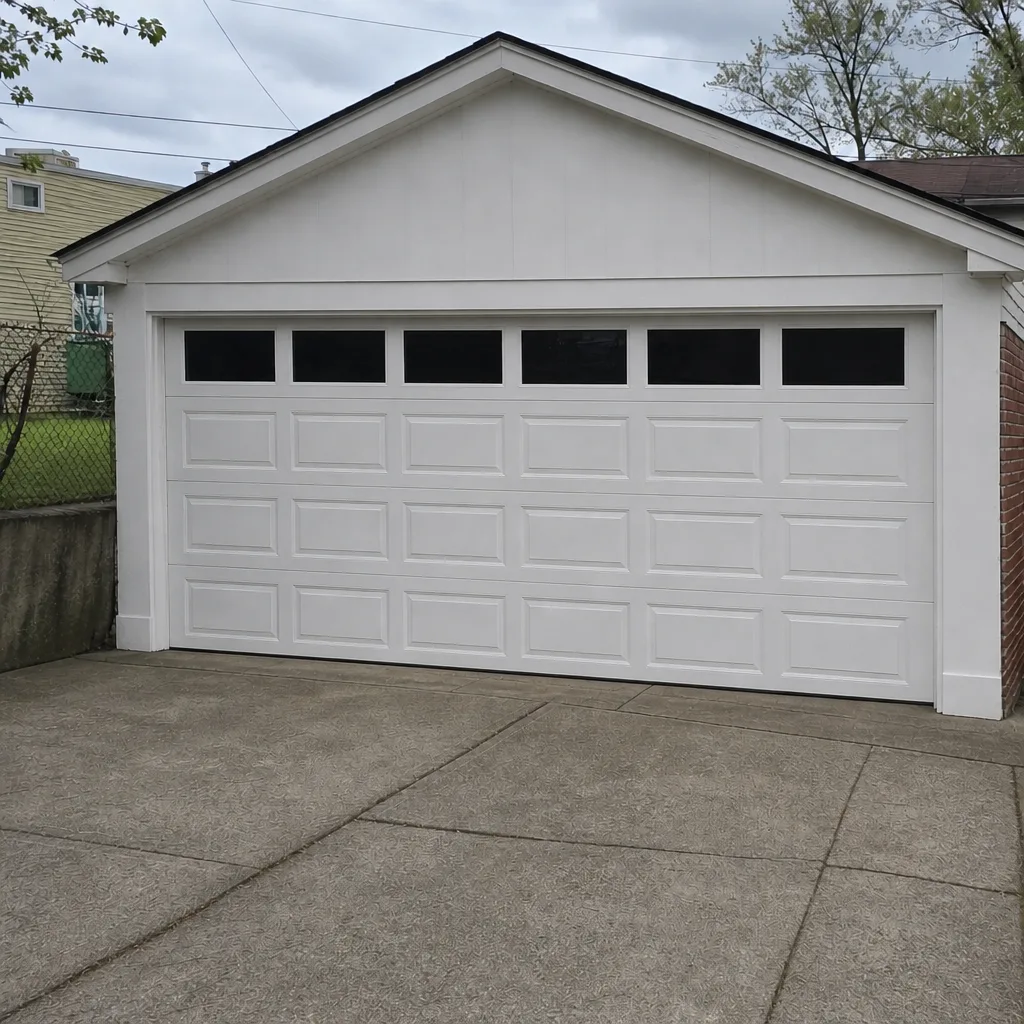 After
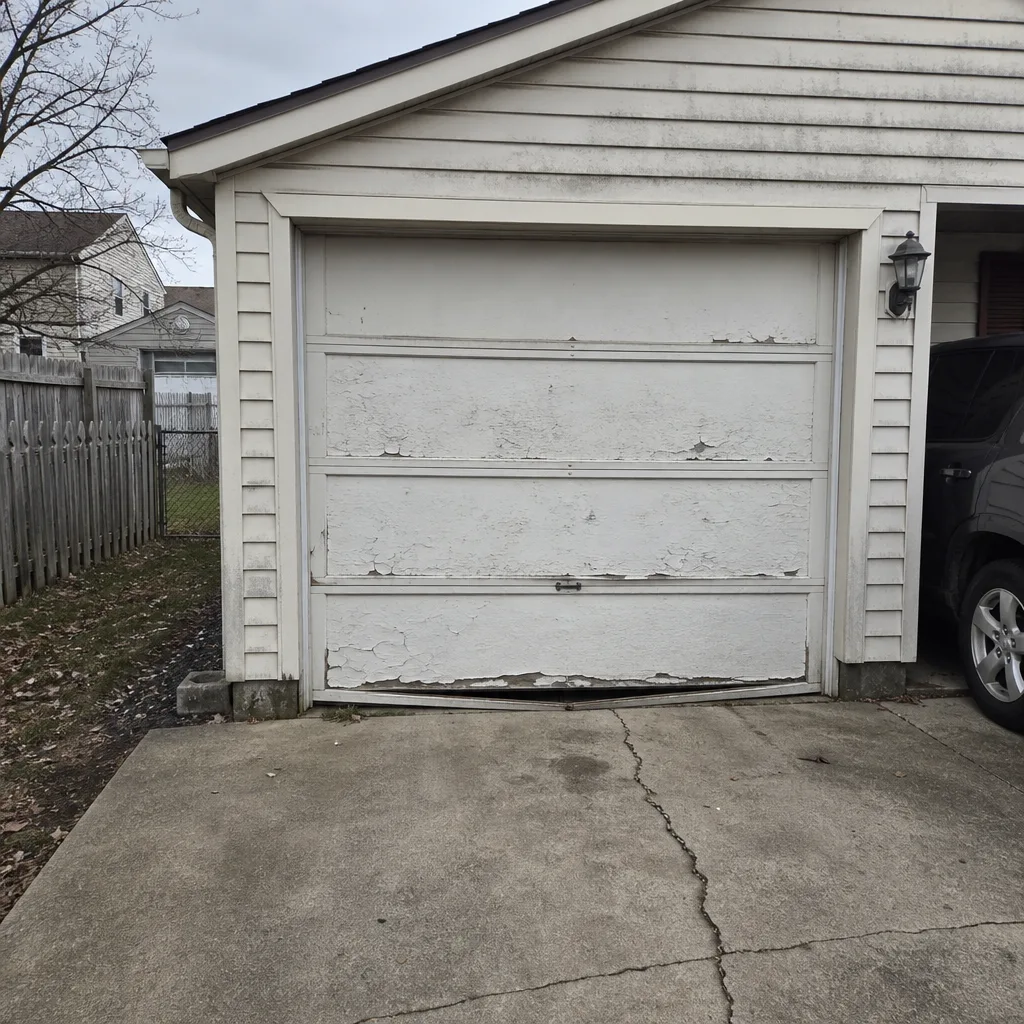 Before
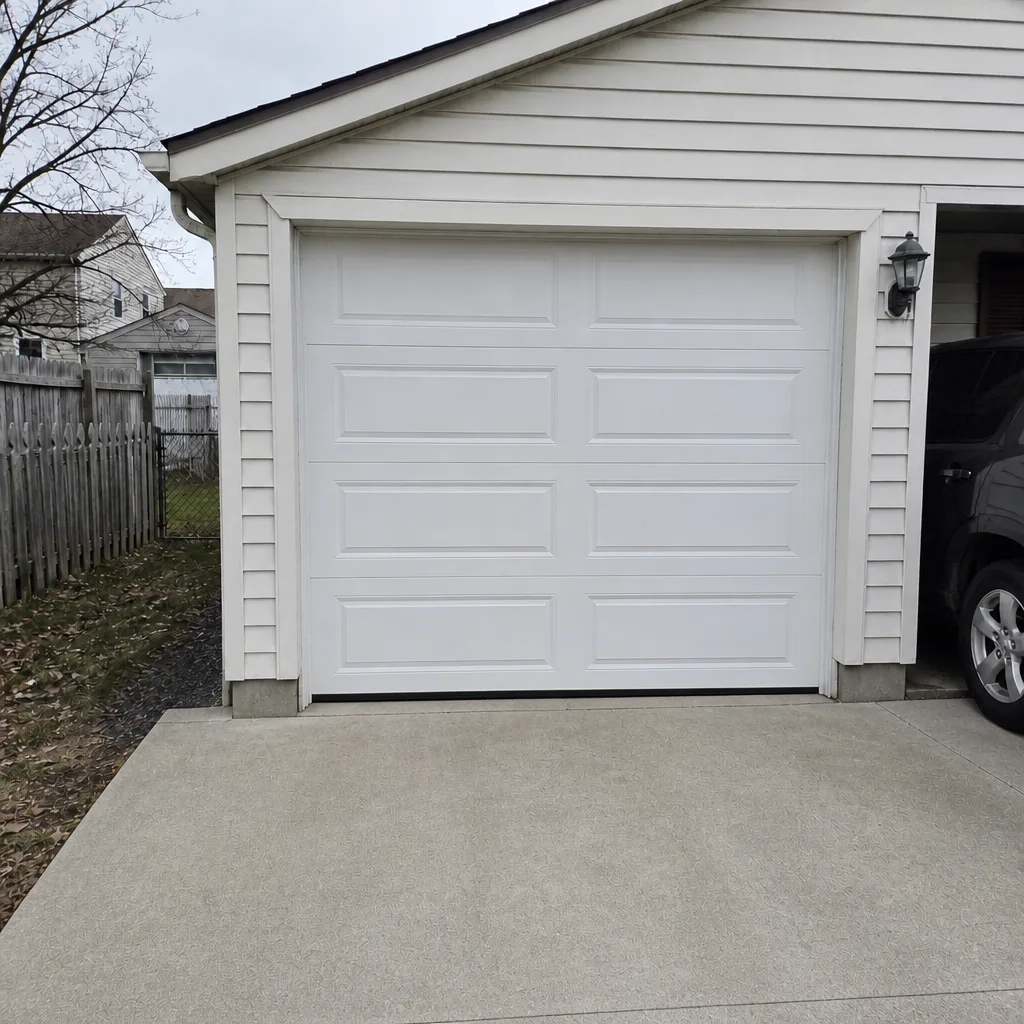 After
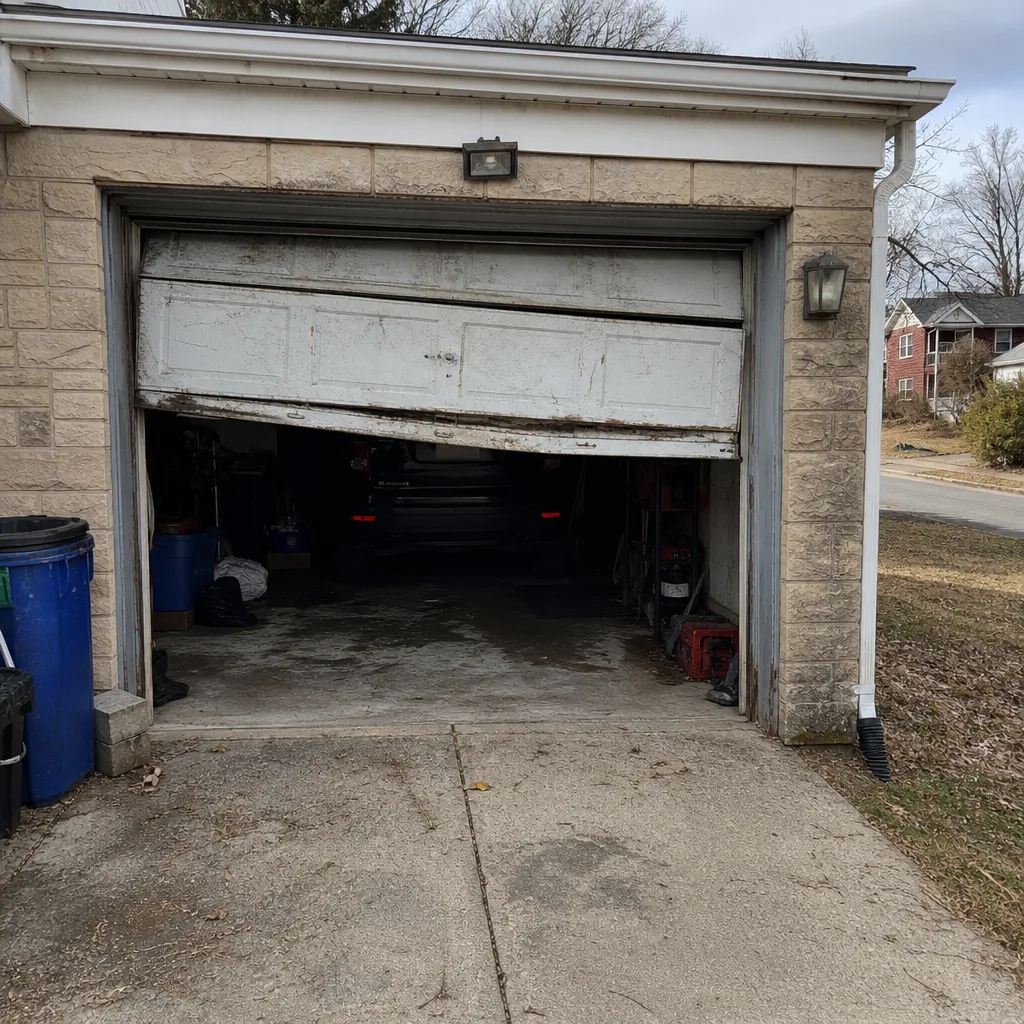 Before
 After
When to Call a Professional
Some maintenance tasks are yours: visual checks, lubrication, and tightening a loose hinge bolt. Others need a trained technician, and it’s better to know the difference before something goes wrong.
Call a professional if you notice any of the following: a visible gap, crack, or rust trail on a torsion spring; a frayed or kinked cable; a door that drops when you let it go halfway; a door that binds or shudders at a specific point in travel; an opener that won’t reverse on contact; or a loud bang followed by a door that won’t lift. These all point to spring, cable, track, or opener issues that need proper diagnosis and repair. A technician’s value here isn’t just the repair. It’s the diagnosis – checking spring tension, spring balance, cable condition, roller wear, and track alignment in a single pass, which is a much better outcome than handling one guessed-at part and waiting to see if it fixed the problem.
Garage Door Repair Carrick offers free estimates in Carrick. Not sure whether a symptom is a DIY fix or a service call? Call (833) 508-9951. We answer 24/7, and our technicians have up to 12 years of experience working on LiftMaster, Chamberlain, Genie, Clopay, Amarr, Wayne Dalton, Craftsman, and Raynor systems.
Frequently Asked Questions
Quarterly is the right interval for residential doors, not annually. Rollers, hinges, and the torsion spring need a light application of the right lubricant every three months to maintain the film that prevents metal-on-metal wear. Applying the correct product quarterly does more for the door’s life than a single heavy annual application.
No, and this is the most common maintenance mistake we see. WD-40 is a penetrating solvent, not a long-term lubricant. It dissolves the grease inside roller bearings and then evaporates, leaving the bearing dry. Use white lithium grease on metal parts and silicone spray on plastic and rubber parts instead. If a hinge is genuinely stuck, a penetrating oil can free it, followed by a proper grease application.
Plan on replacement every 5 to 7 years, based on use. Springs are rated in cycles, and a typical residential door reaches its rating on that timeline. Waiting for a break means the door fails at the worst possible moment, and emergency repair plus freeing the door can cost more than a scheduled replacement. If your spring has been on the door for more than 5 years, it’s worth having it looked at.
Freeze-thaw cycles in the Carrick area cause three things: bottom seals stiffen and stop conforming to the floor, ground movement shifts track alignment, and cold makes torsion spring steel more brittle. A door that feels heavier in January than it did in October is showing spring fatigue that cold weather makes more likely to end in a break. A fall pre-winter check catches these before they become failures.
Record the date, what you did, what you noticed, and what you left for a professional. The observations matter most: specific noises at specific points, daylight under the seal, or a roller that looks different. A technician can use that history to diagnose faster, and it turns a maintenance routine into a useful service record.
Yes, on an annual basis. A working door can be close to a spring failure without showing it. A technician checks spring tension, balance, cable condition, and opener force in a single visit, which catches wear that a visual walk-around can’t. It’s the difference between planning a repair and dealing with a door that won’t shut.
The Bottom Line
Garage door maintenance isn’t about doing everything once a year. It’s about matching the task to the interval that fits how each part wears. Check cables and seals monthly. Lubricate with the right product quarterly – white lithium on metal, silicone on plastic and rubber, and nothing on electronics. Test balance, spring condition, and opener force annually. Replace springs on a 5 to 7 year cycle rather than waiting for a break. In Carrick, add a pre-winter check to catch the freeze-thaw issues that show up in January.
Most of this schedule costs you a few minutes a month. The one task that doesn’t belong on your list is spring work, and the earlier you flag a problem, the cheaper and simpler it is to fix.
If you’d like a technician to walk through the schedule on your own door, or if you’ve noticed something worth a closer look, call Garage Door Repair Carrick at (833) 508-9951 for a free estimate. We answer 24/7. Fast dispatch from 7am to 7pm, Sunday through Friday.
Written by the team at Garage Door Repair Carrick.